Practical Stereotomy for Timber Framing
May 11–15, 2026
Hosted at Revival Timberworks — Rayne, Louisiana
Understanding Stereotomy in Timber Framing
Stereotomy is the craft of resolving three-dimensional geometry into workable form. In timber framing, it provides a direct method for understanding and executing complex roof geometry, compound joinery, and intersecting surfaces using full-scale drawing rather than abstract calculation.
This five-day workshop introduces participants to traditional stereotomical methods through hands-on practice. Emphasis is placed on visual and geometric problem-solving using full-size layout (épure / tracing floor), allowing geometry to be verified before it is transferred to timber.
Course Description
This immersive week pairs historical methods with practical shop and site work. Drawing from French l’Art du Trait, German Schiftung, and related traditions, participants learn to convert spatial geometry into accurate timber layout and joinery.
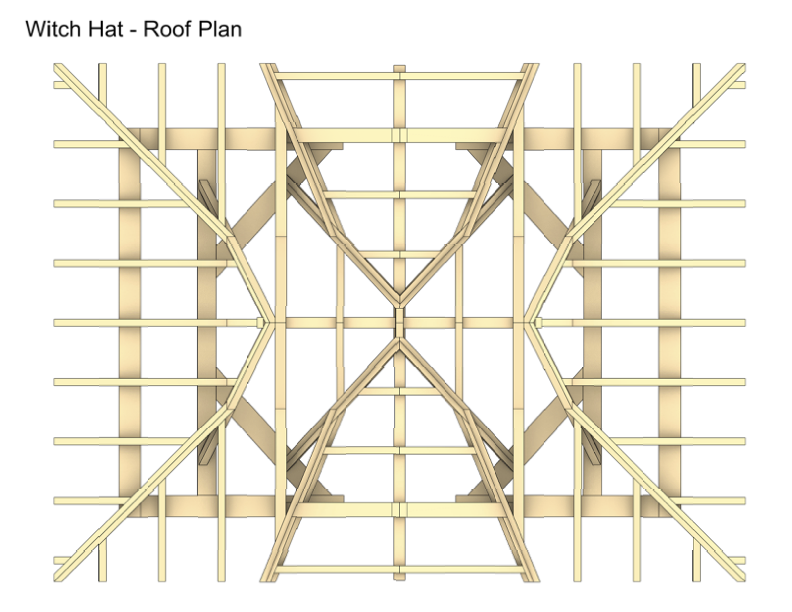
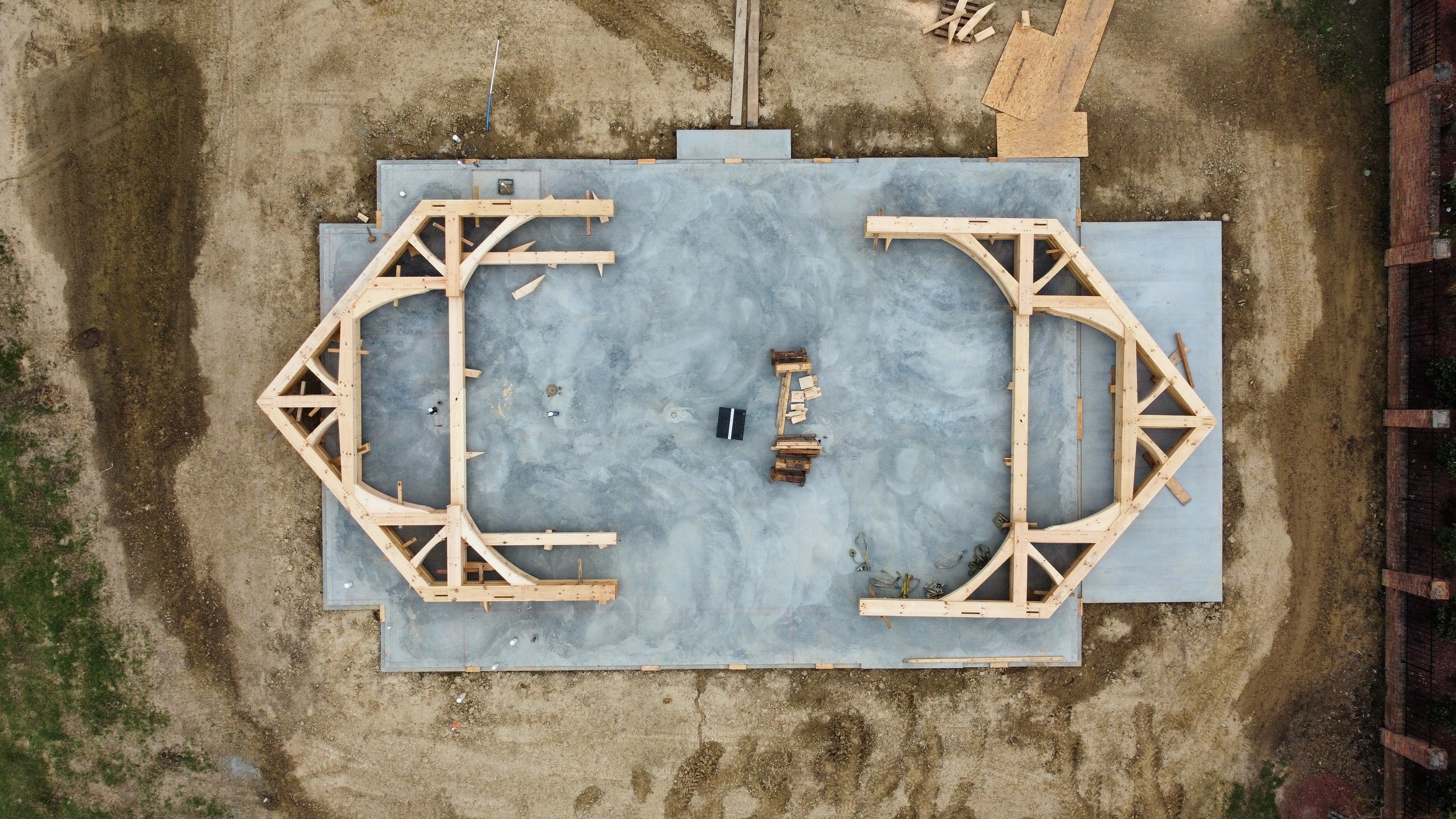
Rather than relying on software or formula-based abstraction, the course centers on concrete drawing and tracing methods that produce immediate, repeatable results. Participants prepare full-scale working drawings, lay out and cut timber components, and assemble a timber frame structure designed to demonstrate complex roof framing.
Have questions?
Give us a call or click below.
Who This Workshop Is For?
This workshop is intended for carpenters, timber framers, preservation professionals, architects, structural engineers, and advanced students interested in traditional layout techniques and their application to complex roof work.
Participants should have basic familiarity with timber framing and hand-and-power woodworking tools. A willingness to work on the floor with pencils, compasses, and timber is essential.
Method, Structure, Tools and Materials
Instruction proceeds through a continuous cycle of drawing, layout, cutting, and assembly. Geometry is developed at full scale, transferred directly to timber, and verified through assembly.
Rather than separating design from execution, the workshop treats drawing and making as a single integrated process.
Participants are encouraged to bring their own layout and timber framing tools. A recommended tool list is offered below.
If you are busy and don’t have time to gather tools Revival Timberworks can supply all of required tools. Tool arrangements are made after seat reservation and tools may be shipped to participants following the workshop if necessary.
Our Instructor
Patrick Moore
Patrick Moore is a classically trained stereotomist and the founder of the Professional School of Practical Stereotomy — a unique institution dedicated to teaching historical layout and surface development methods rooted in the French L’Art du Trait tradition. He is widely recognized as one of North America’s foremost practitioners in traditional geometric layout and timber construction.
Patrick’s formal training spans multiple craft disciplines and international traditions. He completed extensive schooling in Europe and North America, including study with the esteemed Compagnons du Devoir in France — where in 2013 he became the first person from the Western Hemisphere to be received as a Compagnon Passant Charpentier du Devoir. His masters work from La Grande École des Hommes de Métier en Compagnonnage and related study in carpentry and masonry inform a deep understanding of the geometry underlying complex structural form.
He holds multiple industry credentials, including Red Seal certification in carpentry and cabinetmaking, advanced academic degrees in construction and heritage trades, and numerous professional awards for craftsmanship, leadership, and heritage education. His work has been exhibited in museums globally — including in Canada, France, Japan, and Mexico — and he has contributed to restoration projects on nationally and internationally classified historic structures, including two UNESCO World Heritage Sites.
Patrick’s teaching emphasizes a clear, step-by-step progression that leads students from basic geometric understanding to autonomous visual-spatial problem solving. He brings a global perspective to traditional craft, combining historical methods with contemporary applications in timber framing, conservation, and custom construction.